
Must Read Books by Arab-American Authors

At Belonging Books, we stand by the fact that reading is a political act. Diverse stories shape how we understand the world and people in it by seeing, valuing, and remembering the lives of others. April is recognized for a number of month-long observances, and one of those that we are highlighting in store is Arab-American Heritage Month. Celebrate with us by checking out a diverse range of Arab and Arab-American voices across genres, with a particular focus on Palestinian authors whose stories continue to be marginalized, supporessed, and underrepresented in many spaces.
You can shop these books from our online store using the button below each book. If a book is out of stock, you can special order it from Belonging Books, or support us through our Bookshop.org page.
Table of Contents:
Fiction
These novels explore the lives of Arab and Arab-American characters through personal storytelling drawn from the authors' lived experiences, whether they focus on themes of family, love, autonomy, or exile.

Evil Eye by Etaf Rum
Yara Murad has worked hard to outrun the demons of her tumultuous Brooklyn childhood. Now living far from home, Yara has achieved everything she aspired to: She is highly educated and teaches art to college student. She's also raising two daughters with her businessman husband, Fadi. Her marriage is nothing like her parents' high-conflict relationship, and she knows her life is worlds better and freer than her mother’s.
So why doesn’t it feel that way? Why does Yara experience flashes of anger out of nowhere or a sadness she can’t name? When an incident at the college threatens her job, her mother suggests that a family curse could be to blame. While Yara doesn’t believe in old superstitions, she's shaken as she finds her carefully constructed world beginning to implode. To save herself, Yara must finally confront the childhood she thought she’d left behind and forge her own path forward.

A Woman is No Man by Etaf Rum
Palestine, 1990. Seventeen-year-old Isra prefers reading books to entertaining the suitors her father has chosen for her. Over the course of a week, the naïve and dreamy girl finds herself quickly betrothed and married, and is soon living in Brooklyn. There Isra struggles to adapt to the expectations of her oppressive mother-in-law Fareeda and strange new husband Adam, a pressure that intensifies as she begins to have children—four daughters instead of the sons Fareeda tells Isra she must bear.
Brooklyn, 2008. In a poignant coming of age story, eighteen-year-old Deya, Isra’s oldest daughter, must meet with potential husbands at her grandmother Fareeda’s insistence, though her only desire is to go to college. Deya can’t help but wonder if her options would have been different had her parents survived the car crash that killed them when Deya was only eight. But her grandmother is firm on the matter: the only way to secure a worthy future for Deya is through marriage to the right man.
But fate has a will of its own, and soon Deya will find herself on an unexpected path that leads her to shocking truths and long-buried family secrets—knowledge that will force her to question everything she thought she knew about her parents, the past, and her own future.

The Coin: A Novel by Yasmin Zaher
The Coin’s narrator is a wealthy Palestinian woman with impeccable style and meticulous hygiene. And yet the ideal self, the ideal life, remains just out of reach: her inheritance is inaccessible, her homeland exists only in her memory, and her attempt to thrive in America seems doomed from the start.
In New York, she strives to put down roots. She teaches at a school for underprivileged boys, where her eccentric methods cross boundaries. She befriends a homeless swindler, and the two participate in an intercontinental scheme reselling Birkin bags.
But America is stifling her—her willfulness, her sexuality, her principles. In an attempt to regain control, she becomes preoccupied with purity, cleanliness, and self-image, all while drawing her students into her obsessions. In an unforgettable denouement, her childhood memories converge with her material and existential statelessness, and the narrator unravels spectacularly.

Against the Loveless World by Susan Abulhawa
As Nahr sits, locked away in solitary confinement, she spends her days reflecting on the dramatic events that landed her in prison in a country she barely knows. Born in Kuwait in the seventies to Palestinian refugees, she dreamed of falling in love with the perfect man, raising children, and possibly opening her own beauty salon. Instead, the man she thinks she loves jilts her after a brief marriage, her family teeters on the brink of poverty, she’s forced to prostitute herself, and the US invasion of Iraq makes her a refugee, as her parents had been. After trekking through another temporary home in Jordan, she lands in Palestine, where she finally makes a home, falls in love, and her destiny unfolds under Israeli occupation. Nahr’s subversive humor and moral ambiguity will resonate with fans of My Sister, The Serial Killer, and her dark, contemporary struggle places her as the perfect sister to Carmen Maria Machado’s Her Body and Other Parties.

My Friends by Hisham Matar
One evening, as a young boy growing up in Benghazi, Khaled hears a bizarre short story read aloud on the radio, about a man being eaten alive by a cat, and has the sense that his life has been changed forever. Obsessed by the power of those words—and by their enigmatic author, Hosam Zowa—Khaled eventually embarks on a journey that will take him far from home, to pursue a life of the mind at the University of Edinburgh.
There, thrust into an open society that is miles away from the world he knew in Libya, Khaled begins to change. He attends a protest against the Qaddafi regime in London, only to watch it explode into tragedy. In a flash, Khaled finds himself injured, clinging to life, unable to leave Britain, much less return to the country of his birth. To even tell his mother and father back home what he has done, on tapped phone lines, would expose them to danger.
When a chance encounter in a hotel brings Khaled face-to-face with Hosam Zowa, the author of the fateful short story, he is subsumed into the deepest friendship of his life. It is a friendship that not only sustains him but eventually forces him, as the Arab Spring erupts, to confront agonizing tensions between revolution and safety, family and exile, and how to define his own sense of self against those closest to him.
Memoir & Personal Narrative
Telling our own stories can be one of the greatest acts of resistance, especially when pitted against censorship. These Arab-American authors challenge erasure by offering nuanced perspectives of their community's experience with themes such as migration, memory, and womanhood.

Hail Mariam by Huda Al-Marashi
Hail Mariam is an interfaith Muslim take on Are You There God? It’s Me, Margaret drawn from the author’s own experiences in Catholic school.
Sixth grade wasn’t supposed to be this complicated.
Iraqi American Mariam Hassan transfers to a local Catholic school and before her first day her parents remind her that she might be the first Muslim her classmates have ever met. No big deal, right? Just represent an entire religion while making new friends, keeping up with schoolwork, and figuring out who she is.
When Mariam’s younger sister, Salma, is diagnosed with a serious lung condition, her family faces endless doctor visits and sleepless nights. Mariam tries to lighten their burden and keep her own problems to herself—including the fact that she’s just been cast as Mary in the school’s Christmas nativity play.
Mariam wants to honor her faith and her new community, but she’s terrified of crossing a religious line. Can a Muslim girl be the lead in a Christian story? What will her family think? And why does she feel like every decision she makes represents all Muslims?
Mariam discovers that faith, much like friendships, isn’t about perfection—it’s about connection. As she leans on her family, friends, and school community, she begins to see the power of interfaith cooperation and learns she doesn’t have to carry the weight of the world on her shoulders.
Hail Mariam is a celebration of the beauty of finding common ground.

I Sleep in My Kitchen by Mariam Daud
100 flavor-forward recipes—including signature bakes—from the Palestinian American creator of the beloved social media account mxriyum
Mariam Daud has built a devoted following by sharing beautifully prepared, comforting meals that feel both timeless and entirely her own. In I Sleep in My Kitchen, she offers a collection of the recipes that have shaped her life—dishes that carry the flavors of her heritage and the ease and creativity of a home cook who simply loves to feed others, from cherished classics like her mother’s irresistible Cheese Fatayer, a savory cheese-stuffed pastry, to her takes on everyday favorites like Triple Stack Smash Burgers or tender, pull-apart Cinnamon Rolls.
At the heart of I Sleep in My Kitchen are the flavors Mariam Daud grew up with in her Palestinian American home, including celebratory dishes like Msakhan, the national dish of Palestine, of soft flatbread, caramelized onions, tender stewed chicken, and toasted pine nuts, alongside playful recipes infused with Middle Eastern flavor, like her Mediterranean Pasta Salad with Sumac-Vinaigrette, and Tahini Browned Butter Banana Bread.
Spanning breakfasts, small plates, salads, soups, mains, and her signature sweet and savory baked goods, this collection includes many of her most-loved recipes as well as brand-new creations, including Bang Bang Shrimp Tacos with Cabbage Slaw, Fluffy Browned Butter Rolls, and a Loaded Chickpea Salad with Bulgur.
I Sleep in My Kitchen is an invitation to cook with generosity and curiosity, to explore the food that connects us to memory, place, and one another.
Poetry & Essays
These collections center survival, grief, resistance, and shine a light on the emotional toll that displacement takes on the self.
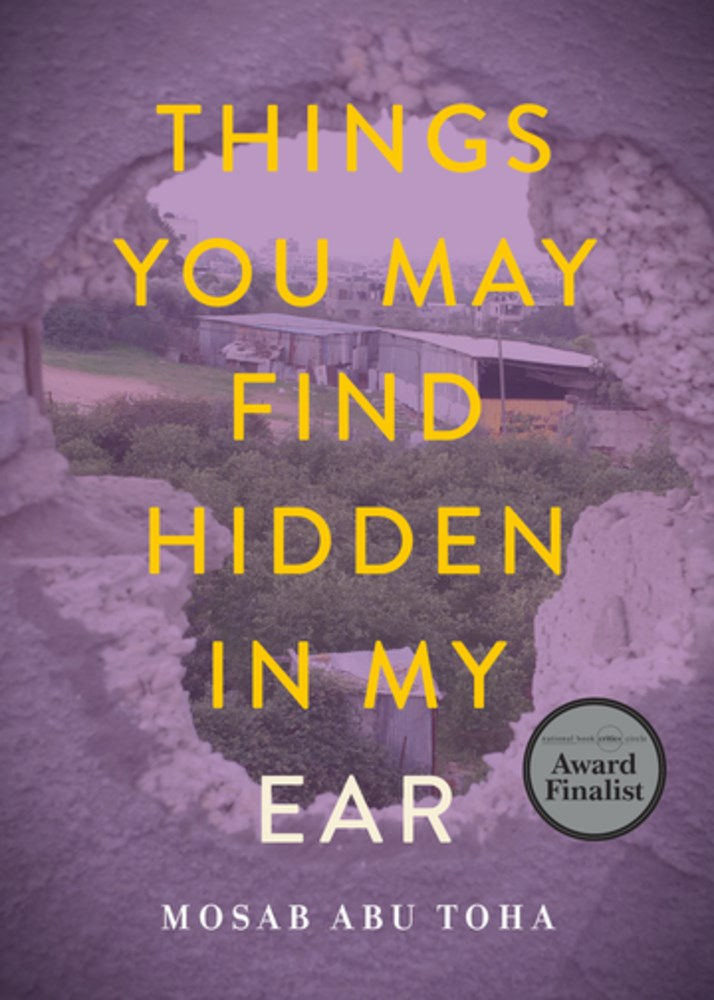
Things You May Find Hidden in My Ear by Mosab Abu Toha
In this poetry debut Mosab Abu Toha writes about his life under siege in Gaza, first as a child, and then as a young father. A survivor of four brutal military attacks, he bears witness to a grinding cycle of destruction and assault, and yet, his poetry is inspired by a profound humanity.
These poems emerge directly from the experience of growing up and living in constant lockdown, and often under direct attack. Like Gaza itself, they are filled with rubble and the ever-present menace of surveillance drones policing a people unwelcome in their own land, and they are also suffused with the smell of tea, roses in bloom, and the view of the sea at sunset. Children are born, families continue traditions, students attend university, and libraries rise from the ruins as Palestinians go on about their lives, creating beauty and finding new ways to survive.

Forest of Noise: poems by Mosab Abu Toha
Barely thirty years old, Mosab Abu Toha was already a well-known poet when the current siege of Gaza began. After the Israeli army bombed and destroyed his house, pulverizing a library he had painstakingly built for community use, he and his family fled for their safety. Not for the first time in their lives.
Somehow, amid the chaos, Abu Toha kept writing poems. These are those poems. Uncannily clear, direct, and beautifully tuned, they form one of the most astonishing works of art wrested from wartime. Here are directives for what to do in an air raid; here are lyrics about the poet’s wife, singing to his children to distract them. Huddled in the dark, Abu Toha remembers his grandfather’s oranges, his daughter’s joy in eating them.
Moving between glimpses of life in relative peacetime and absurdist poems about surviving in a barely livable occupation, Forest of Noise invites a wide audience into an experience that defies the imagination—even as it is watched live. Abu Toha's poems introduce readers to his extended family, some of them no longer with us. This is an urgent, extraordinary, and arrestingly whimsical book. Searing and beautiful, it brings us indelible art in a time of terrible suffering.

One Day, Everyone Will Have Always Been Against This by Omar El Akkad
On October 25, 2023, after just three weeks of the bombardment of Gaza, Omar El Akkad put out a tweet: “One day, when it’s safe, when there’s no personal downside to calling a thing what it is, when it’s too late to hold anyone accountable, everyone will have always been against this.” This tweet has been viewed more than 10 million times.
As an immigrant who came to the West, El Akkad believed that it promised freedom. A place of justice for all. But in the past twenty years, reporting on the War on Terror, Ferguson, climate change, Black Lives Matter protests, and more, and watching the unmitigated slaughter in Gaza, El Akkad has come to the conclusion that much of what the West promises is a lie. That there will always be entire groups of human beings it has never intended to treat as fully human—not just Arabs or Muslims or immigrants, but whoever falls outside the boundaries of privilege. One Day, Everyone Will Have Always Been Against This is a chronicle of that painful realization, a moral grappling with what it means, as a citizen of the U.S., as a father, to carve out some sense of possibility in a time of carnage.
This is El Akkad’s nonfiction debut, his most raw and vulnerable work to date, a heartsick breakup letter with the West. It is a brilliant articulation of the same breakup we are watching all over the United States, in family rooms, on college campuses, on city streets; the consequences of this rupture are just beginning. This book is for all the people who want something better than what the West has served up. This is the book for our time.
Journalism, History, and Political Analysis
These works provide context on Palestine, imperialism, and resistance. Consider these very important resources for understanding historical and contemporary realities.

The Hundred Years' War on Palestine: A History of Settler Colonialism and Resistance, 1917-2017 by Rashid Khalidi
A landmark history of one hundred years of war waged against the Palestinians from the foremost US historian of the Middle East, told through pivotal events and family history.
In 1899, Yusuf Diya al-Khalidi, mayor of Jerusalem, alarmed by the Zionist call to create a Jewish national home in Palestine, wrote a letter aimed at Theodore Herzl: the country had an indigenous people who would not easily accept their own displacement. He warned of the perils ahead, ending his note, “in the name of God, let Palestine be left alone.” Thus Rashid Khalidi, al-Khalidi’s great-great-nephew, begins this sweeping history, the first general account of the conflict told from an explicitly Palestinian perspective.
Drawing on untapped archival materials and the reports of generations of family members—judges, scholars, diplomats, and journalists—The Hundred Years' War on Palestine upends accepted interpretations of the conflict, which tend, at best, to describe a tragic clash between two peoples with claims to the same land. Instead, Khalidi traces a century of colonial war on the Palestinians, waged first by the Zionist movement and then Israel, but backed by Britain and the United States, the great powers of the age. He explores the key events in this war, from the 1917 Balfour Declaration to the destruction of Palestine in 1948, from Israel’s 1982 invasion of Lebanon to the endless, futile peace process.
Neither a chronicle of victimization nor a whitewash of mistakes made by Palestinian leaders, this history offers an original and illuminating new view of a conflict that continues to this day.

Before the Flood: A Gaza Family Memoir Across Three Generations of Colonial Invasion, Occupation, and War in Palestine by Ramzy Baroud
The social, political, and historical context of the current Israeli-Palestinian War told through the stories of the author’s family and village.
A profound exploration of Palestinian history and resilience through the personal stories of the author’s family—the al-Badrasawis. Beginning with intimate details of village life in Beit Daras prior to the Nakba, Ramzy Baroud vividly portrays the rich cultural heritage, deeply rooted traditions, and daily struggles faced by ordinary people whose lives were radically disrupted by the violent upheavals and ongoing conflicts driven by British colonialism and Zionist aggression.
Baroud weaves together past and present, illuminating how historical forces shaped the collective consciousness and steadfast resilience of the Palestinian people. His storytelling reveals not only the harsh realities of occupation, displacement, and loss but also the extraordinary courage, faith, and solidarity that underpin a powerful and enduring spirit of resistance, encapsulated in what the author refers to as the Palestinian “longue durée.” Ultimately, Baroud aims to humanize and reclaim Palestinian narratives from distorted portrayals, highlighting their perseverance and the universal quest for justice and liberation.

Gaza: The Story of a Genocide by Fatima Bhutto
An urgent and powerful collection of personal testimony, poetry, art, and frontline reportage of the genocide in Gaza, told by Palestinians.
Gaza: The Story of a Genocide is Together, bears witness to the vast and ongoing destruction inflicted on the Palestinian people—their lives, their land, and their future.
Ahmed Alnaouq recounts the devastating loss of twenty-one family members. Noor Alyacoubi offers a searing reflection on starvation. Mariam Barghouti examines the brutality of Israeli settler violence in the West Bank, while Eman Bashir describes the phenomenon of a “wounded child, no surviving family.” These voices, among many others, illuminate the enduring psychological, physical, and generational toll of state violence.
With contributions from recipients of the Palestine Book Award, Arab American Book Award, Pulitzer Prize, Emmy Award, National Book Award, and Gandhi Peace Award, this collection also honors the late poet Hiba Abu Nada—killed in an Israeli airstrike on her home in Khan Younis, Gaza, on October 20, 2023.
All royalties will be donated directly to the United Nations Relief and Works Agency (UNRWA) for Palestine Refugees in the Near East.

The Eyes of Gaza: A diary of Resilience by Plestia Alaqad
In early October 2023, Palestinian Plestia Alaqad was a recent university graduate dreaming of a career as a journalist. But by the end of November, her homeland was unrecognizable—and she was broadcasting videos of violence and destruction to millions online, known across the world as "The Eyes of Gaza."
A series of diary extracts from the weeks following October 7, The Eyes of Gaza is a gutting, on-the-ground record of the turmoil and destruction endured by the men, women, and children of Palestine. As Alaqad flees from neighborhood to neighborhood, from hospital to hospital, she documents all she sees—the destruction of beloved homes, the waves of bombs, and most of all, the boundless bravery and generosity of her people—all the while trying to memorize the faces of those around her "so somebody will have known them before the end," wondering if, one day, her own journal will be discovered amidst the rubble.
A document of the indomitable Palestinian spirit, told through the voice of one ordinary young woman, The Eyes of Gaza is a tribute to Alaqad's beloved Gaza, a paean to the courage and endurance of Palestine, and a manifesto of hope for its future.
Young Adult & Middle Grade
Accessible entry points for readers looking for stories centering young Arab and Arab American people navigating identity, belonging, and displacement.

Other Words for Home by Jasmine Warga
A gorgeously written, hopeful middle grade novel in verse about a young girl who must leave Syria to move to the United States, perfect for fans of Jason Reynolds and Aisha Saeed.
Jude never thought she’d be leaving her beloved older brother and father behind, all the way across the ocean in Syria. But when things in her hometown start becoming volatile, Jude and her mother are sent to live in Cincinnati with relatives.
At first, everything in America seems too fast and too loud. The American movies that Jude has always loved haven’t quite prepared her for starting school in the US—and her new label of “Middle Eastern,” an identity she’s never known before.
But this life also brings unexpected surprises—there are new friends, a whole new family, and a school musical that Jude might just try out for. Maybe America, too, is a place where Jude can be seen as she really is.
This lyrical, life-affirming story is about losing and finding home and, most importantly, finding yourself.

You Started It by Jackie Khalilieh
Seventeen-year-old Jamie Taher-Foster has big plans for senior year. She's made a list of things and places in Toronto she and her boyfriend of three years, Ben Cameron, need to check off before graduating. And the biggest plan of all: a very special night for the two of them at the upcoming Winter Formal. But then Ben arrives back home after a summer away with an unthinkable announcement: he wants to break up.
And when Jamie discovers him with Olivia Chen the next day, she is determined to get him back. Even if that means fake dating the younger, curly-haired, TikTok dancer Axel Dahini, whose bicycle she accidentally ran over.
Though she and Axel have nothing in common aside from their shared Arab heritage — she's a messy, type A with anxiety; he's carefree but meticulous — their forced time together brings them to better understand one another. And for Jamie, it just might mean learning that not all experiences or people need to be crossed off a list.
Children's Books
For our youngest readers, children's books provide a first introduction to themes of displacement and belonging, helping to build an early foundation rooted in love and global awareness.

Everything Grows in Jiddo's Garden by Jenan Matari and illustrated by Aya Ghanameh
Jiddo’s garden is a wonder. In it grows so many amazing things—to see, smell, and taste. But helping him to tend the garden teaches this young girl about even more than fig trees. It gives her a chance to discover just who she is.
Many years ago, like so many Palestinians, her family was forced to leave their homeland. But Jiddo shows her how, until they can return, tending a garden can connect them to home—and to each other!
This heartwarming debut picture book by Jenan Matari explores themes of displacement, belonging, and an enduring connection to the land. With stunning illustrations by Aya Ghanameh, it’s a poignant celebration of love, identity and hope.
Speculative & Genre Bending
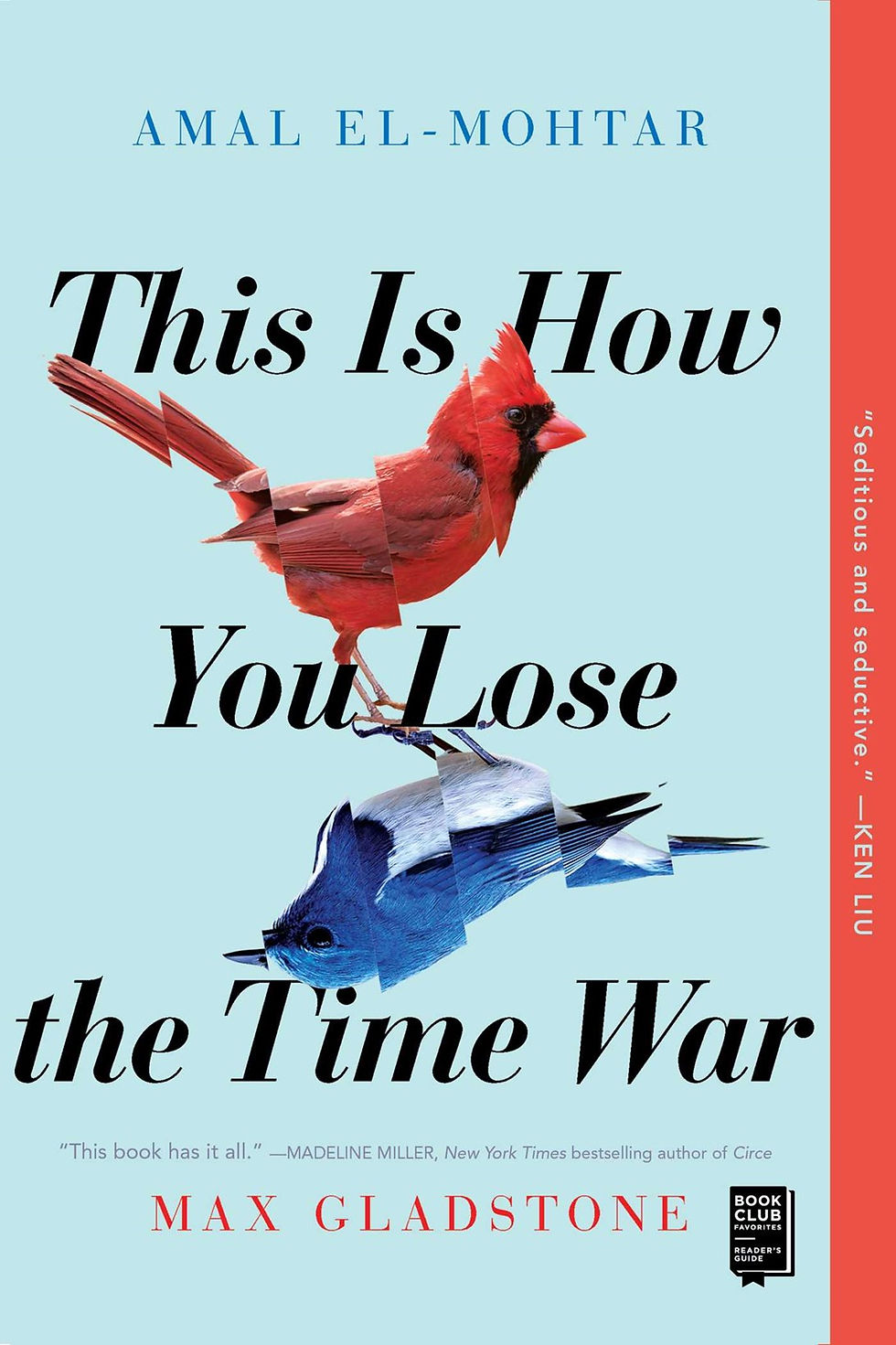
This Is How You Lose the Time War by Amal El-Mohtar and Max Gladstone
Among the ashes of a dying world, an agent of the Commandment finds a letter. It reads: Burn before reading.
Thus begins an unlikely correspondence between two rival agents hellbent on securing the best possible future for their warring factions. Now, what began as a taunt, a battlefield boast, becomes something more. Something epic. Something romantic. Something that could change the past and the future.
Except the discovery of their bond would mean the death of each of them. There’s still a war going on, after all. And someone has to win. That’s how war works, right?
Cowritten by two beloved and award-winning sci-fi writers, This Is How You Lose the Time War is an epic love story spanning time and space.


Comments